

Unlock Dual-Engine Monitoring with the A037
Apr
The A037 Engine Data Monitor & NMEA 2000 Converter is widely known for its ability to convert analogue engine data into NMEA 2000, making it easy to view critical engine parameters on modern displays. But one feature that often goes underappreciated is its ability to monitor up to two engines simultaneously.
If you’re running a twin-engine vessel, this capability can simplify your setup and reduce hardware costs without compromising on data visibility.
Designed for Twin-Engine Installations
The A037 is fully compatible with both single and dual-engine systems, making it a flexible solution for a wide range of vessels.
At the hardware level, the device supports:
- Two RPM (tacho) inputs – ideal for twin-engine configurations
- Multiple sensor inputs for parameters like temperature, pressure, and tank levels
- Full NMEA 2000 output for seamless integration with onboard displays
This means a single unit can collect and transmit data from both engines in real time.
Once configured, the A037 outputs real-time engine data for both engines, including:
- RPM (engine speed)
- Oil pressure
- Coolant temperature
- Battery voltage
- Fuel level and consumption
Giving you full visibility of your vessel’s performance.
The Key: Instance IDs

So how does the A037 distinguish between two engines?
The answer lies in instance configuration.
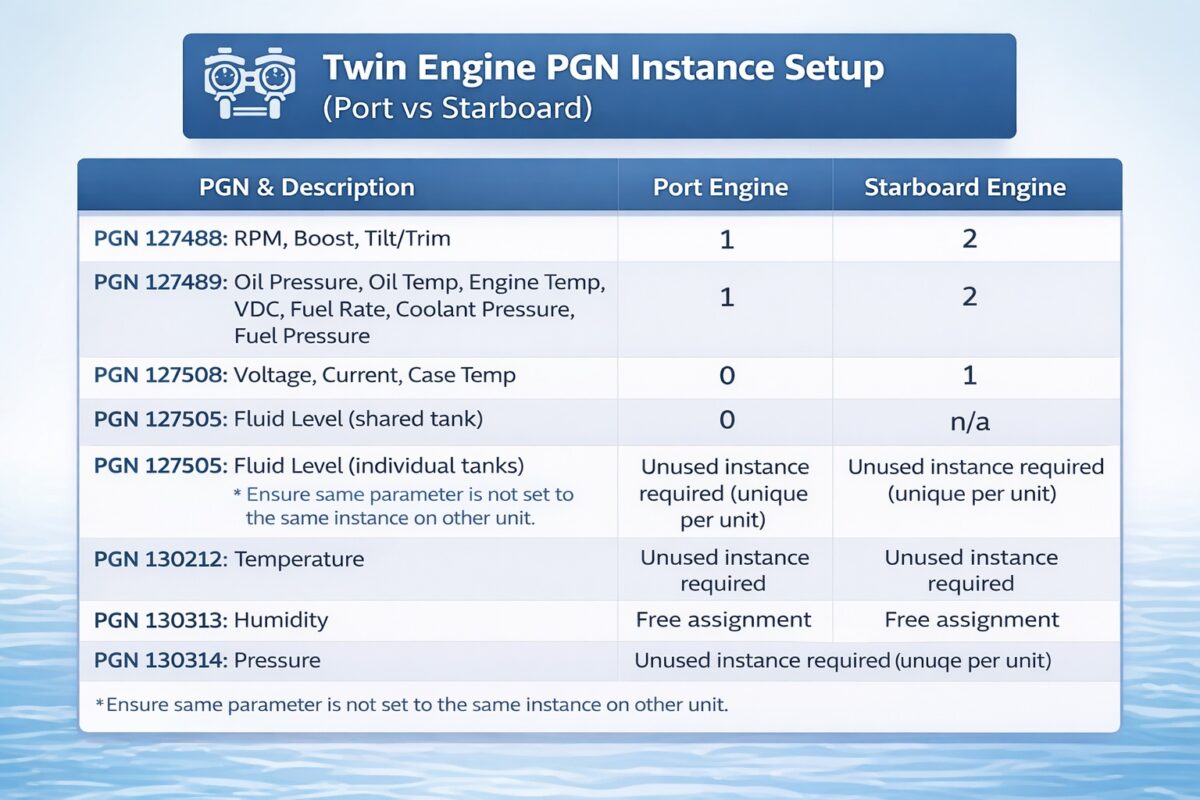
Within the A037’s setup interface, each data source (such as RPM, oil pressure, or temperature) can be assigned a unique instance ID. These instance values are embedded into the NMEA 2000 messages, allowing connected displays (MFDs, chartplotters, etc.) to recognise which engine the data belongs to.
For example:
- Instance 1 → Engine 1 (Port)
- Instance 2 → Engine 2 (Starboard)
By configuring different instance IDs for each engine’s sensors, the A037 ensures that:
- Data streams remain clearly separated
- Displays correctly label each engine
- No data overlap or confusion occurs
Why This Matters
For boat owners and installers, this feature delivers several key benefits:
Reduced Hardware Requirements – Instead of installing two separate monitoring units, a single A037 can handle both engines.
Cleaner Installation – Fewer devices mean simpler wiring, less space used, and faster setup.
Centralised Data Output – All engine data is transmitted through one device onto the NMEA 2000 network, making integration straightforward.
Cost-Effective Solution – Lower equipment costs without sacrificing functionality or performance.
Real-World Use Case

On a twin-engine vessel, the A037 can simultaneously monitor:
- Engine 1 RPM, oil pressure, coolant temperature
- Engine 2 RPM, fuel rate, alternator voltage
All of this data is then output to your NMEA 2000 network, where it can be viewed on compatible displays in real time.
Simple Configuration, Powerful Results
Configuring dual-engine monitoring is straightforward:
- Connect each engine’s sensors to the appropriate inputs
- Assign unique instance IDs to each engine’s data streams
- Enable the relevant NMEA 2000 PGNs
- Save and reboot
Once configured, the A037 will continuously output clearly separated data for both engines.
Conclusion
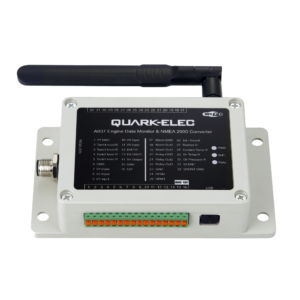
The A037 isn’t just an engine data converter – it’s a smart, scalable monitoring solution.
With built-in support for dual-engine setups via instance ID configuration, it allows you to:
- Monitor two engines from a single device
- Maintain clean, structured NMEA 2000 data
- Simplify your onboard electronics system
If you’re running a twin-engine vessel, the A037 offers a powerful and efficient way to stay in control of your engine data.
